

Renovation projects in Poland can spiral into financial and emotional chaos faster than most homeowners expect. Hidden fees appear after work begins, vague offers lead to endless disputes, and missed deadlines cost you money and sleep. The good news is that transparent, competitive results are absolutely achievable when you follow a clear system. This guide walks you through every critical step, from organizing your project documentation and comparing bids properly, to writing a solid contract, managing daily progress, and communicating in ways that protect you from costly surprises.
Table of Contents
- Gathering the right information before you start
- How to compare bids and contractors: criteria and pitfalls
- Locking it down: Key elements of your construction contract
- Managing timeline, quality, and changes during the project
- Communication and documentation: Your shield against surprises
- What most fail to realize about managing renovations in Poland
- Get professional help for a seamless renovation
- Frequently asked questions
Key Takeaways
| Point | Details |
|---|---|
| Demand detailed bids | Only accept offers with clear scope, itemized costs, and specific materials to prevent hidden fees. |
| Compare apples to apples | Ensure all bids are for the exact same work and standard so you can make fair, informed decisions. |
| Secure a robust contract | Attach all relevant documents and penalty mechanisms in your agreement to protect your interests. |
| Track progress and changes | Use checklists, structured meetings, and meticulous documentation for smooth execution and fewer disputes. |
| Leverage expert platforms | Platforms like justRenovate.it simplify finding trusted contractors and streamline the tendering process. |
Gathering the right information before you start
Once you recognize the risks of ambiguity, your first step is clear preparation. Most renovation disasters start not on the building site but at the kitchen table, when a homeowner describes a project too vaguely and receives offers that cannot be meaningfully compared.
Before you contact a single contractor, you need a complete, written description of what you want done. This means listing every room, every surface, and every material you expect. It also means specifying quality standards: are you expecting basic-grade flooring or premium? Painted walls with one coat or three? Contractors price these very differently, and without clear guidance, they will each assume something different.
Here is what your pre-bid documentation package should include:
- Floor plans or drawings (even rough sketches help)
- Full scope of work, room by room and trade by trade
- Material specifications (brand, grade, or at minimum quality category)
- Site access rules and working hours
- Preferred start date and deadline
- Any existing conditions the contractor must account for (old wiring, asbestos, structural elements)
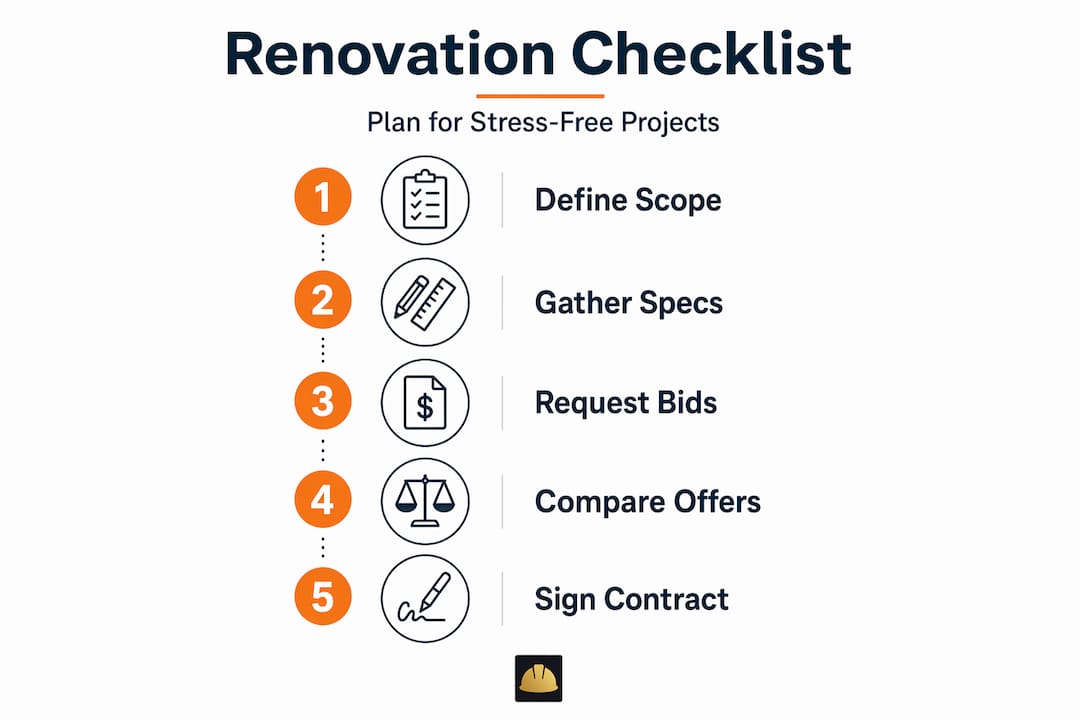
A well-structured renovation checklist helps you organize all of this before you start collecting bids. It also becomes the baseline document against which you measure every offer you receive.
Pro Tip: Create a simple template that lists every item in your scope, with a blank column for unit price, quantity, and total. Require every bidder to fill in that same template. This single step prevents the majority of change order disputes later, because the scope is already fixed in writing before work begins.
When it comes to pricing, always demand a detailed breakdown with unit prices, quantities, and labor rates rather than a single "per square meter" lump sum. Generic pricing hides what you are actually paying for and makes it nearly impossible to hold a contractor accountable when something changes.
| Document | Why it matters |
|---|---|
| Detailed scope of work | Prevents scope creep and vague change orders |
| Material specs | Ensures all bids use the same quality baseline |
| Drawings or measurements | Gives accurate quantities for pricing |
| Timeline requirements | Filters out firms that cannot meet your schedule |
| Site access rules | Avoids misunderstandings during work |
How to compare bids and contractors: criteria and pitfalls
Having prepared a clear set of requirements, you're ready to request and review bids. Here is how to do it safely.
The single biggest mistake homeowners make is comparing the bottom-line number without checking what is actually inside each offer. One contractor might include all materials, electrical work, and waste disposal. Another might price only labor and exclude materials entirely. On paper, the second offer looks cheaper. In reality, it could cost twice as much by the time you add everything in.
To accurately compare offers in Poland, you must confirm that all bids cover the same scope, the same material standards, and the same exclusions before you look at price. Focus on the detailed cost estimate, checking unit prices and quantities line by line.
Here is a straightforward process for reviewing bids:
- Collect at least three bids from verified contractors with a track record.
- Map every bid against your standard template to spot missing items instantly.
- Check for exclusions listed in fine print: VAT, waste disposal, permits, scaffolding.
- Verify the timeline and any conditions attached to it.
- Review the contractor's references, Google ratings, and past project photos.
- Request written clarification for anything you do not fully understand.
Use a side-by-side comparison table like this:
| Criteria | Contractor A | Contractor B | Contractor C |
|---|---|---|---|
| Scope completeness | Full | Partial (no electrical) | Full |
| Material standard | Standard | Premium | Standard |
| Labor price (total) | 18,000 PLN | 22,000 PLN | 16,500 PLN |
| Material price (total) | 12,000 PLN | 14,000 PLN | 11,000 PLN |
| VAT included? | Yes | Yes | No |
| Timeline | 8 weeks | 10 weeks | 7 weeks |
| Exclusions noted | None | None | Waste disposal |
When you use a structured bidding platform, verified companies are required to submit itemized bids, which makes this comparison much faster and more reliable.
"The lowest number is rarely the lowest cost. Dig into the details, and you will often find that a mid-range offer with a complete scope saves you more money than the cheapest bid with hidden gaps."
Pro Tip: Always ask for written clarification in reply to any bid that is unclear or unusually low. A reputable contractor will answer clearly and quickly. One that deflects or speaks only verbally is a red flag. For guidance on selecting reliable building firms, check the vetting criteria before you start. You can also explore alternatives to Zleceniomat.pl if you want to understand the landscape of Polish platforms before making a choice.
Locking it down: Key elements of your construction contract
With your preferred bid in hand, it is vital to formalize the agreement with a robust contract. A verbal agreement, even with a trusted firm, is not enough protection in Polish construction.
The contract is where your pre-bid documentation becomes legally binding. Every item from your scope template should be referenced as an attachment. If it is not in the contract, it is not guaranteed.
Precise scope mapping to documentation attachments and clearly defined penalty mechanisms for delays are essential in Polish construction contracts. Without them, you have no practical leverage if a firm misses your deadline or delivers substandard work.
Your contract must include the following numbered items:
- Full scope of work referenced as a named attachment
- Material specifications attached or explicitly described
- Work schedule with named milestones and completion date
- Payment structure tied to milestones, not just calendar dates
- Penalty clauses for delays (typically a percentage of contract value per day)
- Defect and warranty period with defined response times
- Change order procedure describing how modifications are requested, costed, and approved
- Dispute resolution process aligned with Polish civil law
Always attach or reference the following documents in the contract:
- Architectural drawings or measurement plans
- Technical specification of materials
- Approved work schedule (Gantt or milestone list)
- Insurance documentation of the contractor
- Permit copies where applicable
"A strong contract is not a sign of distrust. It is the foundation that makes a project run smoothly, because everyone knows the rules before work begins."
For templates and detailed guidance, explore renovation contract templates built specifically for Polish homeowners. Getting the contract right upfront costs you a few hours. Getting it wrong can cost you months and serious money.
Managing timeline, quality, and changes during the project
A clear contract is only the start. Project success depends on everyday management and quality control throughout execution.
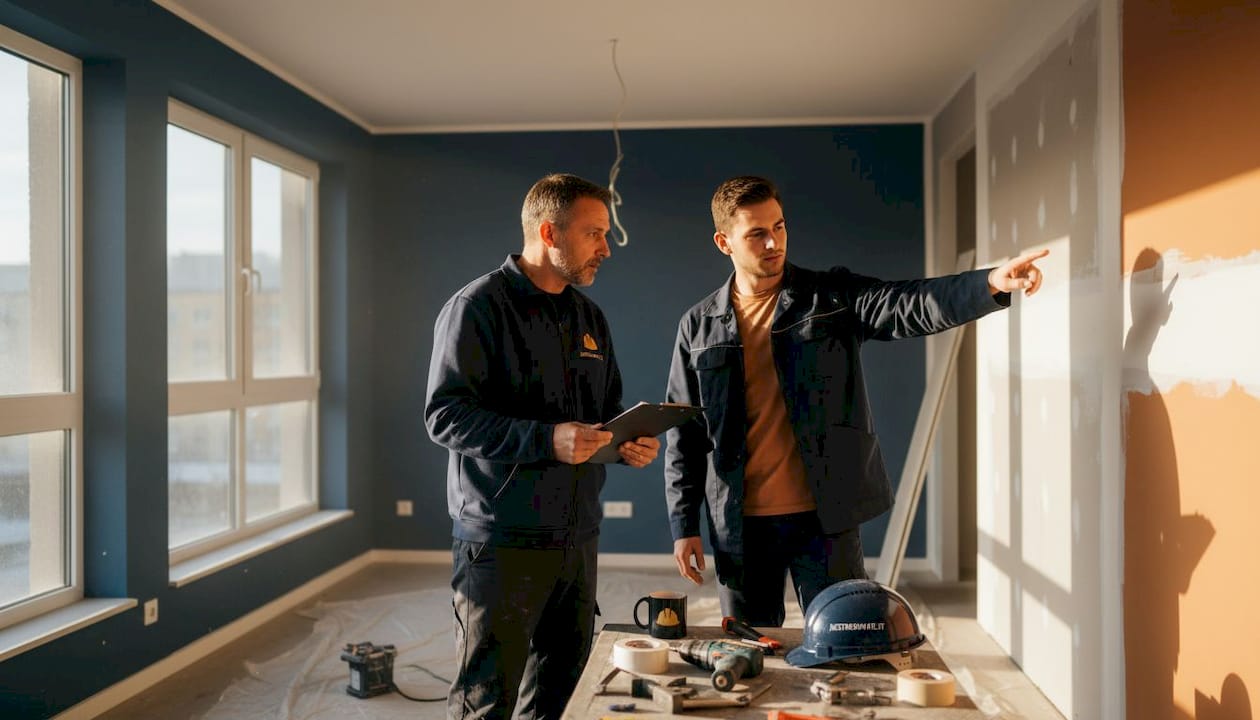
Many homeowners sign a contract and then step back entirely, trusting the contractor to self-manage. This approach leads to unpleasant surprises at handover. The most successful projects involve an engaged client who checks in regularly, reviews progress against the plan, and deals with issues while they are still small.
Renovation scheduling should sequence jobs logically and include time buffers for supply delays and weather disruptions. Track material deliveries alongside physical progress, and monitor actual costs against budget dynamically rather than waiting for the final invoice.
Use a simple progress tracking table updated weekly:
| Phase | Planned start | Actual start | Planned end | Actual end | Status |
|---|---|---|---|---|---|
| Demolition | Week 1 | Week 1 | Week 1 | Week 1 | Complete |
| Electrical rough-in | Week 2 | Week 2 | Week 3 | Week 3 | Complete |
| Plumbing | Week 3 | Week 4 | Week 4 | In progress | Delayed 1 week |
| Plastering | Week 4 | TBD | Week 6 | TBD | Not started |
| Flooring | Week 6 | TBD | Week 8 | TBD | Not started |
Use checklists and documented quality controls for each phase to track defects and price transparency. A simple snagging list updated at each stage prevents problems from piling up until the final walkthrough, when fixing them becomes expensive and disruptive.
Key habits that protect your project during execution:
- Weekly site reviews with written notes and photographs
- Sign-off sheets for each completed phase before the next begins
- Change request forms for every modification, no matter how small
- Material delivery confirmations matched against specification
- Running cost log updated after every invoice or payment
Pro Tip: A quick 30-minute site review every week catches most issues before they become serious problems. Bring your scope checklist, take photos of key areas, and note anything that looks off. Doing this consistently reduces end-of-project disputes dramatically.
For teams that want to move faster and reduce manual tracking, automation in renovation management is increasingly practical and affordable even for smaller projects.
Communication and documentation: Your shield against surprises
Active management is safest when paired with excellent record keeping and scheduled touchpoints. Documentation is not bureaucracy. It is your protection when things go wrong.
Structured meetings at phase kickoffs, documented change agreements, and a non-confrontational tone reduce disputes with contractors significantly. When conversations stay on the record and both parties sign off on agreed changes, the likelihood of disagreements escalates far less often.
Build these communication practices into your project from day one:
- Kickoff meeting before work begins, covering all contract terms, site rules, and expectations
- Weekly progress meetings with written minutes shared to both parties within 24 hours
- Phase completion sign-offs before payment for that phase is released
- Change request log maintained jointly, with cost and timeline impact recorded for each request
- Final walkthrough checklist used at handover, with a snagging list agreed before final payment
How you handle changes mid-project matters enormously. Every change request should be submitted in writing, priced by the contractor before approval, and signed by you before any new work begins. This single habit prevents the vast majority of "surprise" invoices at project end.
"The project owner who documents everything and speaks clearly but firmly will always have more leverage and less stress than the one who lets things slide and hopes for the best."
For a deeper look at how digital tools can help you organize this process, renovation auction platforms are increasingly offering integrated communication features that keep all messages, documents, and approvals in one place.
What most fail to realize about managing renovations in Poland
Stepping back, here is what most guides miss about achieving reliable outcomes in Polish renovation projects.
The dominant belief among Polish homeowners is that cost overruns, delays, and disputes are simply part of renovation life. They are accepted as unavoidable chaos. This belief is wrong, and it is also costly. When you treat disorder as normal, you stop protecting yourself from it.
The truth is that most unexpected costs do not come from bad luck. They come from vague arrangements made before the project starts and lax supervision once it is underway. Two things you can control entirely.
Investing two to three hours in proper documentation before you solicit bids will save you many times that in avoided disputes and rework. Every unclear item in a contract becomes an opportunity for a contractor to charge extra. Every undocumented change request becomes a verbal disagreement with no resolution. Good process is not complicated; it is just consistent.
There is also a counterintuitive truth about contractor relationships. Reliable, professional firms actually prefer working with clients who have strong processes. Clear scopes, detailed specs, and proper contract best practices signal a serious, organized client. The best companies appreciate this because it reduces their own risk and makes projects predictable. Weak processes, by contrast, attract the wrong kind of contractors: those who rely on ambiguity to inflate margins.
Finally, never accept that Polish renovation chaos is simply cultural or inevitable. The homeowners and property managers who achieve on-time, on-budget results are not lucky. They prepare better, ask harder questions, insist on documentation, and stay engaged throughout. You can drive this process. The system can work for you if you make it.
Get professional help for a seamless renovation
If you'd like a shortcut to reliable results, there is a streamlined way to start. Finding verified, competitive contractors in Poland no longer requires cold calls and crossed fingers.

JustRenovate.it is a platform built specifically to bring transparency and competition to Polish renovation projects. You describe your project with AI-assisted tools, and the system generates a detailed scope of work automatically. Verified construction firms with Google ratings of at least 4.0 then compete in a transparent auction, submitting itemized bids that break down robocizny and materiałów separately. You compare prices, experience, and reviews side by side, all for free. The platform even integrates with KSeF for invoicing and supports Polish firms in managing their projects efficiently. Ready to post your renovation project and receive competitive bids today? You can also add your assignment directly, or learn more about justRenovate.it and how the platform works.
Frequently asked questions
Why shouldn't I accept offers with only per-square-meter pricing?
Generic pricing per square meter hides individual costs and makes it nearly impossible to compare offers fairly or hold firms accountable when scope changes. Detailed cost breakdowns significantly reduce the risk of hidden costs appearing later.
How can I avoid disputes during my renovation?
Document every meeting, agreement, and change with written notes and formal sign-offs for each phase. Structured and documented communication is the single most effective way to prevent contractor disputes.
What should be included in a Polish renovation contract?
Always attach documents covering designs, specs, the work schedule, payment milestones, and delay penalties. Contracts should reference all documentation, scope details, and penalty mechanisms to be enforceable and effective.
What is the biggest risk in construction management for homeowners?
Unexpected costs from scope creep and undocumented changes are the biggest financial risks for homeowners. Costly overruns arise mainly from unclear scopes and verbal agreements that shift over time.
How often should site meetings be held during a renovation?
Hold structured site meetings at least once per week and at each phase transition for the best project control. Regular, structured meetings are vital for catching issues early and maintaining momentum.