

Most homeowners believe the cheapest contractor is the smartest choice. That assumption costs people money, time, and serious frustration every year. Renovation auctions challenge that thinking by putting multiple verified contractors head to head, creating real price transparency and a clear view of what you are actually paying for. But auctions are not a magic solution. Used without the right approach, they can introduce risks that catch even experienced property developers off guard. This guide covers exactly how renovation auctions work in Poland, what they can and cannot do for you, and how to use them to secure both fair pricing and reliable quality.
Table of Contents
- What are renovation auctions and how do they work in Poland?
- Core benefits of auction-based renovation procurement
- Common challenges and risks with auction systems
- How to leverage auctions and make informed renovation choices
- Why transparent auctions build trust, but quality needs your guidance
- Connect with vetted contractors through JustRenovate.it
- Frequently asked questions
Key Takeaways
| Point | Details |
|---|---|
| Transparency advantage | Auction-based platforms make contractor pricing and offers visible for fair comparison. |
| Not just price | Balancing quality and experience with cost is key to avoiding poor outcomes. |
| Cost-saving potential | Reverse auctions can deliver 5-25% lower renovation costs for standardized projects. |
| Be cautious | Lowest bids can pose risks; always check references and clear project scope first. |
| Easy platform access | Homeowners can now auction renovation projects online and connect with vetted contractors easily. |
What are renovation auctions and how do they work in Poland?
Now that we have set the context, let's clarify what auction-based renovation really means and where it fits in Polish practice.
In Poland, public renovation tenders (known as przetargi) are the most common form of competitive contractor selection. These primarily apply to housing cooperatives, municipalities, and commercial property owners. The system works by publishing a detailed project scope and inviting multiple licensed firms to submit their bids within a set timeframe. Contractors compete on price, timeline, and often on documented experience.
There are several formats used in Poland today, and understanding the differences helps you pick the right approach for your project.
Main auction types in Poland
| Auction type | Best for | Key feature |
|---|---|---|
| Tryb podstawowy (basic mode) | Standard renovations, straightforward specs | Open competition, fully transparent |
| Reverse auction (aukcja elektroniczna) | Commoditized services (e.g., painting, flooring) | Contractors lower bids in real time |
| Competitive dialogue | Complex, multi-phase renovation projects | Allows pre-bid discussions with shortlisted firms |
| Private platform auctions | Homeowners, small developers | Flexible, accessible without legal formalities |
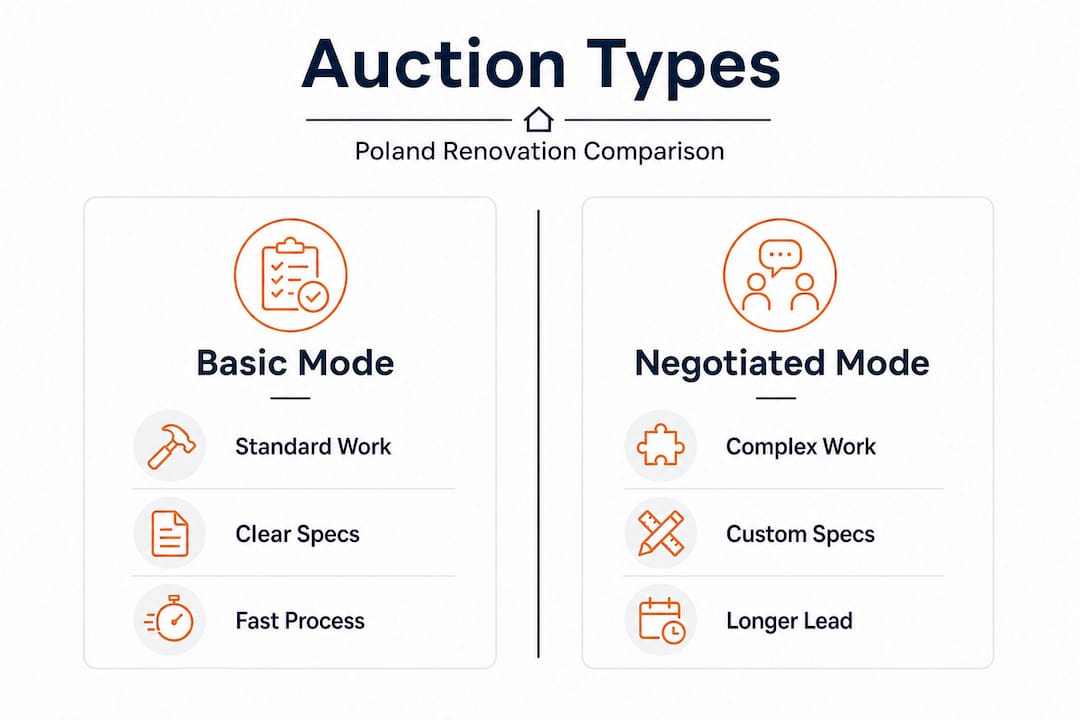
Competitive bidding rules under Polish law require that public tenders follow the tryb podstawowy (basic mode), which ensures every stage is documented and open to scrutiny. This is especially important for housing communities and property managers handling public or shared funds.
Public tenders are published on platforms like Biuletyn Zamówień Publicznych (BZP), Pressinfo.pl, and municipal procurement systems. Private homeowners have more flexibility and can use platforms specifically designed for private renovation projects, like the renovation tenders overview at JustRenovate.it, which operates with a simpler registration process.
A key benefit of these structured formats is transparency. Every bid is logged. Every contractor sees the same project description. There are no backroom deals or verbal agreements that quietly inflate your final invoice. For common renovation tasks like staircase refurbishment, facade repairs, or flooring replacement, auctions tend to drive prices down to genuinely fair market rates.
"Auction-based procurement ensures that the project scope is clearly documented before any work begins, reducing disputes and unexpected costs downstream."
Before you submit your project to any auction process, reviewing a solid renovation planning checklist for Polish homeowners will help you prepare a description that actually attracts strong bids.
Core benefits of auction-based renovation procurement
Once you understand how auctions function, it is crucial to recognize the practical advantages they offer over traditional methods.
The most obvious benefit is cost savings. Reverse auctions yield 5-25% savings for standardized services globally, and the Polish construction market reflects this pattern. When contractors know they are competing in real time against verified peers, they sharpen their pencils. This does not mean you will always get the lowest possible price. It means you will get the fair price, stripped of the premium that often hides in negotiations with a single contractor you found through a personal referral.

Auctions vs. traditional contractor selection
| Factor | Auction method | Traditional negotiation |
|---|---|---|
| Price transparency | High, all bids visible | Low, single quote |
| Contractor competition | Multiple verified firms | Usually one to three firms |
| Time to compare offers | Fast, structured timeline | Slow, informal |
| Risk of inflated pricing | Low | Moderate to high |
| Quality verification | Built into platform criteria | Dependent on personal research |
| Documentation | Automatic, logged | Often verbal or informal |
Auctions also eliminate the awkward negotiation dynamic. You are not sitting across the table trying to push back on a contractor who is also the one you are hoping will show up on time. The system handles the pressure for you.
How a typical renovation auction works for homeowners:
- Describe your project in detail, including room dimensions, materials preferences, and timeline requirements.
- Submit the project description to an auction platform (public or private).
- Verified contractors review your project and submit their initial offers.
- In a reverse auction format, contractors may lower their bids electronically over a set period.
- You receive a structured list of bids showing price breakdowns for labor (robocizny) and materials (materiałów).
- Compare offers side by side, including contractor reviews and experience data.
- Select your preferred contractor and confirm the project scope in writing before work begins.
The automation in auctions used by modern platforms can also auto-generate project descriptions based on your answers to guided questions, saving you significant preparation time.
Pro Tip: The more specific your project description, the more accurate and comparable your bids will be. Vague descriptions lead to wildly different quotes that are nearly impossible to compare fairly. Include measurements, preferred materials, finish quality standards, and your exact timeline.
Common challenges and risks with auction systems
Despite these advantages, not all renovation projects are ideal for pure auction formats. Let's look closer at the limits and what you should watch out for.
Complex renovation tenders work best with simple, clearly specifiable work. The moment your project involves custom design, structural changes, or phased delivery, a pure auction format starts to show its weaknesses. A contractor bidding blindly on a complex scope may underbid just to win the job, then struggle to deliver what you actually need.
This is the core of what procurement professionals call the winner's curse. The winning bid is often the most optimistic, sometimes unrealistically so. The contractor who wins may have underestimated materials costs, labor hours, or the difficulty of accessing the site. That optimism becomes your problem once work begins.
Major risks for homeowners using renovation auctions:
- Underbidding: A contractor quotes low to win, then cuts corners or requests additional payments mid-project.
- Specification gaps: Vague project descriptions allow contractors to interpret scope loosely, leading to disputes.
- Unverified credentials: Using an unverified platform means contractors may lack proper licenses or insurance.
- Price as the only filter: Selecting purely on cost ignores workmanship history, reliability, and communication quality.
- Delays from financial pressure: Construction bankruptcies rose 40% in 2024 partly because competitive pressure pushed firms to take on work they could not profitably complete.
That last point deserves attention. The Polish construction sector faced serious stress in 2024 as rising material costs met aggressive bidding. Firms that won contracts at tight margins often could not sustain the work. Homeowners were left mid-project with no contractor and significant sunk costs.
"Pure price auctions risk the winner's curse, where underbidding leads to poor quality or project delays. Smart procurement always includes quality and experience in the selection criteria."
To protect yourself, your plan for complex renovations should include a mandatory set of minimum qualifications before any bid is even considered. Think of it as a filter that runs before price even enters the conversation.
Pro Tip: Once you have a shortlist of lowest bidders, invest time in verifying each contractor independently. Check their Google reviews, ask for photos of completed projects similar to yours, and request references from clients whose renovations were finished in the last 12 months. Price is the starting point, not the finish line.
How to leverage auctions and make informed renovation choices
Knowing both the opportunities and pitfalls, how do you actually benefit from auction-based contracting in Poland? Here are specific steps for smart selection.
The key insight from hybrid procurement criteria research is clear: pure price competition leads to the winner's curse, while hybrid evaluation that includes quality, experience, and timeline reliability consistently produces better outcomes. This does not mean you ignore price. It means you treat price as one of several factors, not the only one.
Step-by-step guide to smart auction participation:
- Define your project precisely. Write a scope document that includes square footage, material specifications, access requirements, and your desired completion date. Use AI-assisted tools if available to catch gaps in your description.
- Choose a platform with verified contractors. Not all platforms screen their participants. Prioritize platforms where contractors carry a minimum review rating (for example, Google rating of 4.0 or above) and have documented project histories.
- Set minimum qualification criteria. Before bids open, decide your non-negotiable requirements: valid licenses, minimum years of experience, liability insurance, and a portfolio of similar projects.
- Review the full bid breakdown. Look past the total price. A detailed bid should itemize labor costs (robocizny), material costs (materiałów), and any subcontracted work. Hidden costs show up most often in bids that lump everything into a single number.
- Shortlist by value, not just price. After reviewing bids, create a shortlist of two to three contractors who meet your quality criteria and offer competitive pricing.
- Conduct a pre-contract interview. Ask each shortlisted contractor about their current workload, how they handle unexpected issues, and who specifically will manage your project day to day.
- Sign a detailed contract. Never start work based on a verbal agreement or a basic email confirmation. A written contract with payment milestones, defined deliverables, and a penalty clause for delays protects you if things go wrong.
Checklist before accepting any renovation bid:
- Bid includes itemized labor and material costs
- Contractor has verifiable Google reviews above 4.0
- References from recent similar projects provided
- Valid trade license and insurance confirmed
- Project timeline and milestone payments clearly stated
- Warranty terms for completed work included
You can browse active auctions on JustRenovate.it to see how verified contractors structure their bids and compare the level of detail top-rated firms provide.
Pro Tip: Look for platforms that display contractor reviews, completed project histories, and verified credentials alongside their bid amounts. A platform that shows only price is pushing you toward the winner's curse. A platform that shows the full picture is helping you make a genuinely informed decision.
Why transparent auctions build trust, but quality needs your guidance
Let's cut through the industry noise and share the hard-won lessons from years working with both auction and traditional contract models.
The conventional wisdom is simple: more bids equals better results. More competition drives prices down, and lower prices mean more value. This is true in commodity markets. In renovation, it is only partly true, and the missing part matters a great deal.
Auctions do something genuinely valuable. They make the real price spectrum visible. Before you use an auction platform, you may have no idea whether a quote of 40,000 PLN for a bathroom renovation is fair, high, or absurdly low. After five bids come in, you suddenly see the full range. You understand where the market actually sits. That knowledge is powerful, and it is something you simply cannot get from calling two or three contractors individually.
But that visibility does not guarantee quality. It guarantees pricing transparency. Those are two different things.
The homeowners who get the best outcomes from auctions are those who treat the auction result as a starting point, not a final decision. They use the price data to shortlist, then they invest real time into checking the shortlisted firms. They visit completed projects. They talk to previous clients. They look at how a contractor communicates during the inquiry stage, because a contractor who is slow or vague before they have your money will almost certainly be slower and vaguer once they do.
The lesson from renovation automation insights is that technology can do a lot of the heavy lifting in organizing bids, but the final judgment still requires your direct involvement. The best platforms support that judgment by giving you all the information you need in one place. The best homeowners use that information actively rather than defaulting to the lowest number.
Add mandatory minimum standards to your project description before the auction opens. It is far easier to disqualify a non-compliant bidder upfront than to back out of a signed contract later.
Connect with vetted contractors through JustRenovate.it
Ready to put these insights into action? JustRenovate.it brings together everything this guide covers into a single, practical platform.

JustRenovate.it is Poland's auction-based renovation platform built specifically for homeowners and property developers who want transparency without the complexity. You describe your project using an AI-assisted tool that guides you through the scope step by step. Verified contractors with a minimum Google rating of 4.0 then compete for your project, submitting detailed bids that break down labor and material costs separately. You compare offers, reviews, and experience in one clean interface, all completely free for project owners. Explore contractor auctions to see active bids, or post your renovation project and let verified professionals come to you.
Frequently asked questions
How do I start a renovation auction in Poland?
To start, register with a recognized auction platform like JustRenovate.it, fill in your project tender details, and invite bids from vetted contractors. Most private platforms guide you through the project description step by step, so no prior procurement experience is needed.
Are auction-based offers always the lowest priced?
Auctions encourage competitive pricing, but the best practice is to balance price with contractor experience and quality. Hybrid selection criteria consistently outperform pure price selection in terms of final project satisfaction.
What are the main risks of using auctions for renovation projects?
The primary risk is underbidding, where a contractor quotes low to win and then delivers substandard work or asks for extra payments mid-project. Construction bankruptcies in Poland rose 40% in 2024, partly reflecting the pressure that aggressive bidding creates on smaller firms.
Should I use auctions for every renovation project?
Auctions work best for simple, well-defined tasks like painting, flooring, or facade repair. Complex or multi-phase projects may benefit from competitive dialogue formats that allow pre-bid discussions with shortlisted contractors before final bids are submitted.