
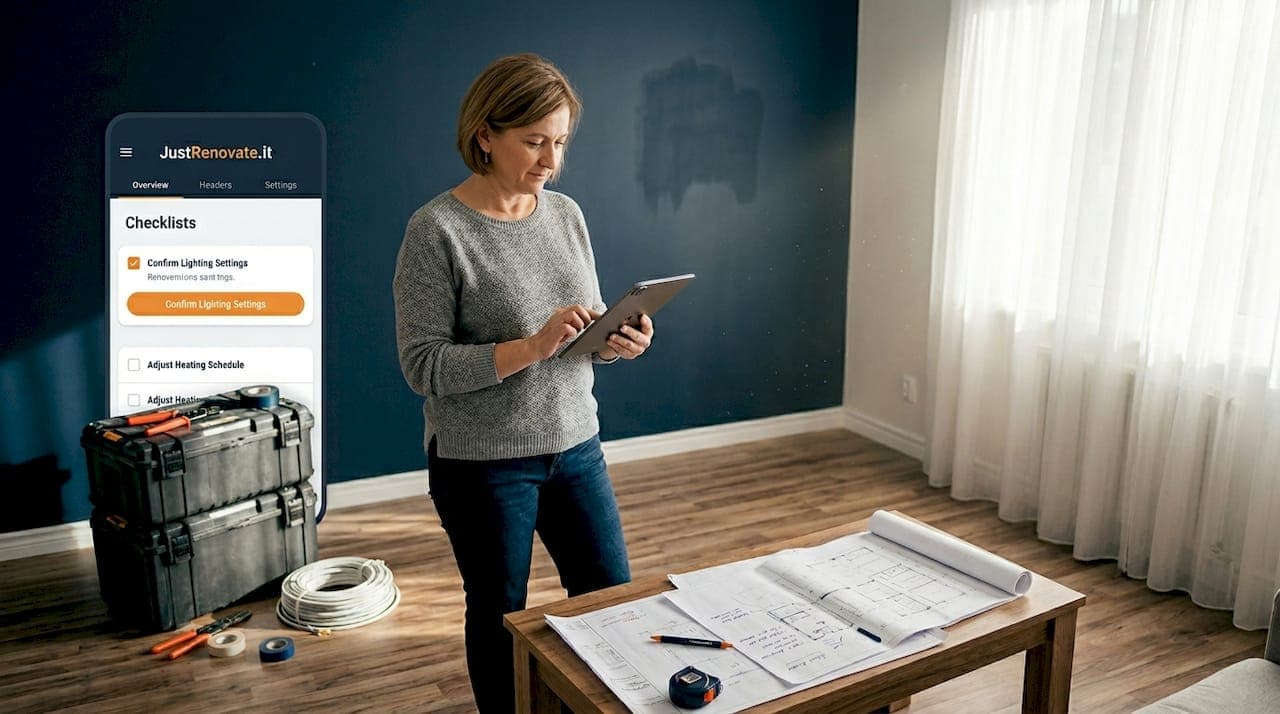
Renovation projects in Poland have a reputation for running over budget and over schedule. But that reputation is becoming outdated fast. Automation in renovation now covers everything from software tools for design and cost estimation to smart home integration and even physical robotics for tasks like facade inspection and insulation. For Polish homeowners, this shift is not a distant trend. It is happening right now, and understanding it can save you real money, real time, and a lot of frustration before your next project even begins.
Table of Contents
- What automation means for renovation
- How intelligent automation reduces renovation costs and hassles
- Smart coordination: How platforms simplify finding reliable contractors
- Emerging trends: Robotics and the future of automated renovation
- Limitations, challenges, and the automation paradox
- Our take: Where automation shines and where a human touch is essential
- Streamline your renovation: The next step for Polish homeowners
- Frequently asked questions
Key Takeaways
| Point | Details |
|---|---|
| Major cost savings | Automation in Polish renovations can reduce operational expenses by up to 30% or even 80% for specific systems. |
| Better contractor selection | OSS platforms and digital tools make finding reliable renovation teams faster and more transparent. |
| Robotics on the rise | Advanced robotics are beginning to automate complex renovation tasks, saving time and reducing errors. |
| Limitations of automation | Not all renovation tasks can be automated—human expertise is still critical for design and oversight. |
| Balanced approach wins | The best results come from using automation tools alongside skilled professionals for smart, efficient projects. |
What automation means for renovation
Let us start with a clear definition. Automation in home renovation does not mean robots doing everything while you sit back. It means using smart tools and systems to handle tasks that used to require hours of manual work, phone calls, or guesswork.
Renovation automation breaks down into four main categories:
- Design and visualization tools: Software that generates floor plans, 3D models, and material lists automatically based on your inputs
- Project management platforms: Digital systems that track timelines, budgets, and contractor progress in real time
- Smart home integration: Automated lighting, heating, and security systems installed as part of the renovation
- Physical robotics: Drones, cable robots, and quadruped machines that handle tasks like facade inspection, insulation spraying, and bricklaying
In traditional renovation, each of these areas required separate specialists, multiple meetings, and a lot of back-and-forth communication. Today, a single platform can coordinate several of these functions at once.
In Poland specifically, the adoption of these tools has accelerated. You can now browse Polish renovation tenders online, compare contractor bids digitally, and receive AI-generated project scopes without making a single phone call. That is a fundamental change in how renovation gets done.
"Automation is not replacing the skilled tradesperson. It is removing the friction that slows them down and costs homeowners money."
The practical result for you as a homeowner is fewer surprises. When a platform generates a detailed scope of work automatically, there is less room for misunderstandings between you and your contractor. When project management software tracks progress daily, delays get caught early rather than discovered at the end.
How intelligent automation reduces renovation costs and hassles
Understanding automation's scope is one thing. Seeing the actual numbers is another. Let us look at what Polish homeowners are experiencing in practice.
Building Management Systems, commonly called BMS, are integrated platforms that control a building's heating, ventilation, lighting, and security from a single interface. When installed during a renovation, they deliver measurable results. BMS and intelligent automation reduce operational costs by 20 to 30% in Polish buildings, with automated lighting alone achieving up to 80% savings compared to traditional systems.
Here is a simple comparison of what that looks like in practice:
| System | Traditional monthly cost | Automated monthly cost | Savings |
|---|---|---|---|
| Lighting (100 sqm apartment) | ~320 PLN | ~64 PLN | Up to 80% |
| Heating control | ~900 PLN | ~630 PLN | ~30% |
| Overall operational costs | Baseline | 20-30% lower | Consistent |
These are not theoretical projections. They reflect real outcomes from buildings across Poland that have adopted smart automation during renovation.
How does automated lighting actually work? Sensors detect whether a room is occupied and adjust light levels accordingly. Motion detection turns lights off in empty hallways. Daylight sensors dim artificial lighting when natural light is sufficient. None of this requires you to remember to flip a switch. The system handles it automatically, every single day.
Automated heating works similarly. Smart thermostats learn your schedule and adjust temperatures before you arrive home, rather than running at full power all day. They also respond to weather forecasts, reducing heating output on warmer days without you having to intervene.
Pro Tip: If you are planning a renovation and want the best return on investment from automation, start with heating control and lighting. These two systems consistently deliver the fastest payback periods, often within two to three years, and they integrate easily with most existing building structures in Poland.
The European Union is also pushing this direction. The Energy Performance of Buildings Directive (EPBD) requires member states, including Poland, to improve building energy efficiency over the coming years. Homeowners who install smart automation during renovation are not just saving money today. They are also future-proofing their properties against upcoming regulatory requirements. Choosing a reliable renovation platform that understands these requirements can help you plan accordingly from the start.
Smart coordination: How platforms simplify finding reliable contractors
Beyond in-home devices, smart platforms now handle the toughest part of any renovation: organizing reliable contractors.
Finding a trustworthy contractor in Poland has traditionally been a painful process. You ask neighbors for recommendations, search online, make a dozen phone calls, wait for quotes that arrive in different formats, and then try to compare them without a clear framework. It is time-consuming and stressful.

Digital platforms and One-Stop-Shop (OSS) models are changing this completely. OSS platforms coordinate all renovation actors, from initial assessment to contractor matching to project completion, through a single digital interface.
A strong example is OSS krk HubRenowacji, Poland's first One-Stop-Shop for renovation. It serves southern Poland, a region with over 12 million inhabitants, and focuses on thermal modernization for multi-apartment buildings. The platform connects building owners with certified contractors, energy auditors, and financing advisors through a single coordinated system.
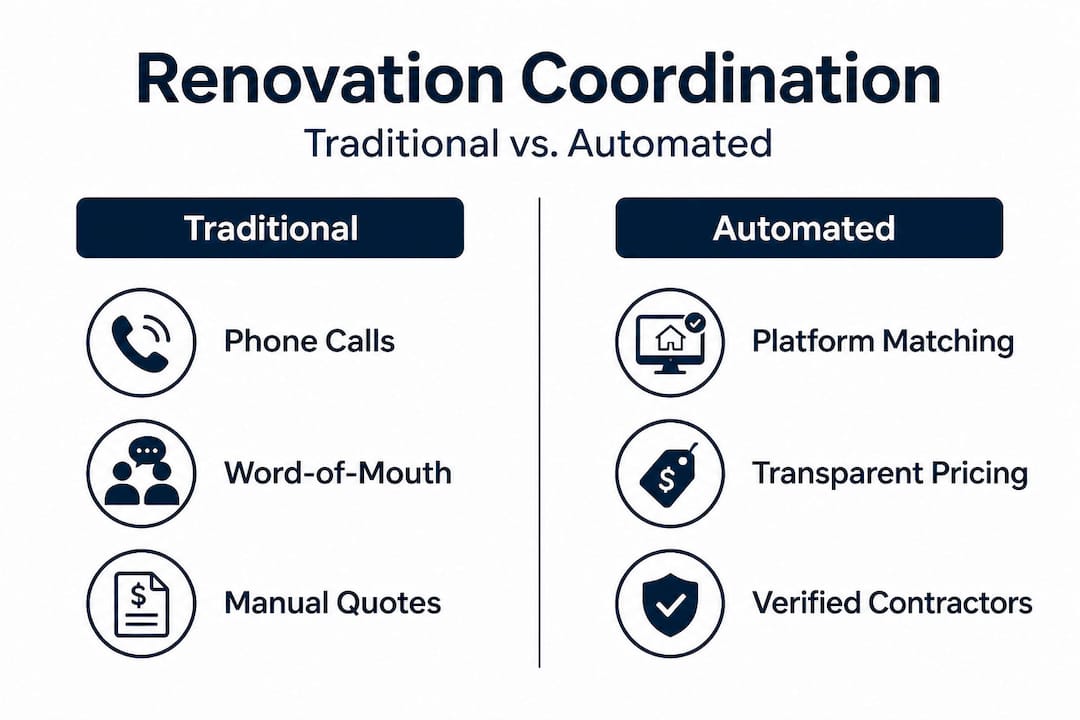
Here is how the traditional approach compares to a platform-based approach:
| Factor | Traditional approach | Platform-based approach |
|---|---|---|
| Finding contractors | Phone calls, word of mouth | Automated matching, verified profiles |
| Getting quotes | Waiting 1 to 2 weeks | Competitive bids within days |
| Comparing offers | Manual, inconsistent formats | Standardized, side-by-side comparison |
| Contractor verification | Unclear, self-reported | Ratings, reviews, platform vetting |
| Communication | Phone and email, scattered | Centralized, documented |
| Risk of miscommunication | High | Low |
The benefits go beyond convenience. When contractors know they are competing on a transparent platform, they submit more competitive bids. When their ratings are visible to all users, they are more motivated to deliver quality work. This creates a healthier market for everyone.
Using contractor matching tools that combine automated vetting with competitive bidding gives you something that was previously very hard to get: genuine price transparency with verified quality signals.
Key advantages of platform-based contractor selection include:
- Faster access to multiple verified bids without chasing contractors individually
- Standardized quote formats that make comparison straightforward
- Documented communication that protects both parties
- Rating systems that reward quality and flag poor performers
- Reduced risk of the project scope being misunderstood
Emerging trends: Robotics and the future of automated renovation
Now, let us look to the horizon. Robotics and advanced tools are reshaping the renovation landscape in ways that will affect Polish homeowners within the next few years.
The EU-funded RADIANCE project is testing robotics for facade renovation across Poland, Norway, and Spain. The robots being piloted include drones for facade inspection and mapping, cable robots for surface preparation and insulation application, and quadruped robots for navigating complex building environments. The goal is to make facade renovation faster, safer, and more sustainable.
Why does this matter for a homeowner in Warsaw or Kraków? Because facade renovation is one of the most expensive and logistically complex parts of any major building upgrade. Traditional methods require scaffolding, large crews, and weeks of work. Robotic systems can inspect a facade in hours, identify problem areas with precision, and apply insulation materials with consistent quality that is difficult to achieve manually.
"Robotic systems do not get tired, do not take shortcuts, and do not misread a measurement. For tasks requiring extreme precision across large surface areas, they outperform human crews on consistency every time."
The cost savings from precision work are real. A layout robot from Raise Robotics avoided between $100,000 and $130,000 in rework costs and prevented six weeks of delays on a large construction project by marking building layouts with precise accuracy. Errors in marking lead to expensive corrections later. Robots eliminate those errors at the source.
Here are three specific ways robotics will affect Polish homeowners within the next three to five years:
- Lower facade renovation costs: As robotic systems become commercially available, the cost of exterior insulation and repair projects will drop significantly due to reduced labor hours and fewer rework incidents.
- Faster project timelines: Robotic inspection and preparation work will compress the early phases of renovation, meaning your project starts productive work sooner and finishes earlier.
- Better quality documentation: Drones and sensors generate detailed reports on building conditions before and after work, giving homeowners clear evidence of what was done and how well.
These are not science fiction scenarios. They are active pilot programs with documented results, moving toward commercial deployment across the EU.
Limitations, challenges, and the automation paradox
Even as these advancements take hold, it is critical to recognize where automation can fall short. Savvy renovators need a realistic picture.
The automation paradox is a real phenomenon. As automation handles more routine tasks, the human skills needed to manage those tasks can erode over time. A human-robot hybrid approach is consistently recommended: use automation to handle repetitive, data-heavy, or physically dangerous tasks, while keeping skilled humans in charge of judgment calls, creative problem-solving, and relationship management.
For Polish homeowners, the practical challenges of automation include:
- Upfront investment: Smart home systems and BMS installations require significant initial spending before savings materialize
- Integration difficulties: Older buildings, which make up a large portion of Poland's housing stock, may require additional work to integrate modern systems
- Training requirements: Both homeowners and contractors need time to learn new platforms and tools
- OT/IT convergence issues: Connecting operational technology (building systems) with information technology (management platforms) can create technical complications
- Regulatory navigation: Understanding which upgrades qualify for EU or Polish government incentives requires research
The AI revolution in facilities management brings genuine optimism about speed and cost savings, but experts consistently note that upfront investment and integration challenges are real barriers that homeowners should plan for, not ignore.
Pro Tip: When evaluating any renovation automation tool or platform, ask specifically how it handles human oversight. The best systems combine automated efficiency with clear points where a qualified human reviews decisions. Platforms that remove human judgment entirely from complex renovation decisions should be treated with caution.
The key is not to avoid automation. It is to choose automation tools that are designed with human expertise built in, rather than tools that promise to replace it entirely.
Our take: Where automation shines and where a human touch is essential
Here is our honest perspective for Polish homeowners considering automation in their renovation.
Automation is genuinely powerful for specific, well-defined tasks. Cost estimation, contractor matching, project tracking, smart home control, and energy management are all areas where automation consistently outperforms manual methods. These are tasks where speed, consistency, and data accuracy matter most, and where human error is both common and costly.
But renovation is not only a technical process. It is also a personal one. Choosing finishes, resolving unexpected structural issues, managing the stress of living through a major project, these require human judgment, experience, and communication skills that no software can fully replicate. A contractor who understands your priorities and communicates clearly is worth more than any algorithm.
The typical tech-optimist guide tells you that automation will solve everything. We disagree with that framing. Automation solves specific, predictable problems very well. It struggles with the unpredictable, the emotional, and the highly customized. A kitchen renovation where you are making dozens of aesthetic decisions is not the same as an energy efficiency upgrade where the optimal outcome is mathematically defined.
Our recommendation is straightforward. Use automation as a tool to remove friction, not as a replacement for skilled human involvement. Use platforms that give you transparent data and verified contractor information. Use smart home systems that deliver measurable savings. But keep a qualified professional involved in decisions that require judgment, creativity, or deep local knowledge of Polish building regulations and materials.
The homeowners who get the best results from renovation are those who combine the efficiency of automation with the reliability of trusted, verified professionals. That combination is more powerful than either approach alone.
Streamline your renovation: The next step for Polish homeowners
If you are ready to bring automation to your own renovation, here is a proven way to get started.
JustRenovate.it is built specifically for Polish homeowners who want the benefits of automation without the complexity. You describe your renovation scope with the help of an AI assistant, and the platform generates a detailed work list automatically. Verified contractors with a minimum Google rating of 4.0 then submit competitive bids, including itemized breakdowns of labor (robocizny) and materials (materiałów). You compare offers side by side, with full transparency on pricing and contractor history. The entire process is free for homeowners, with platform fees paid by contractors only after project completion and your confirmed satisfaction.
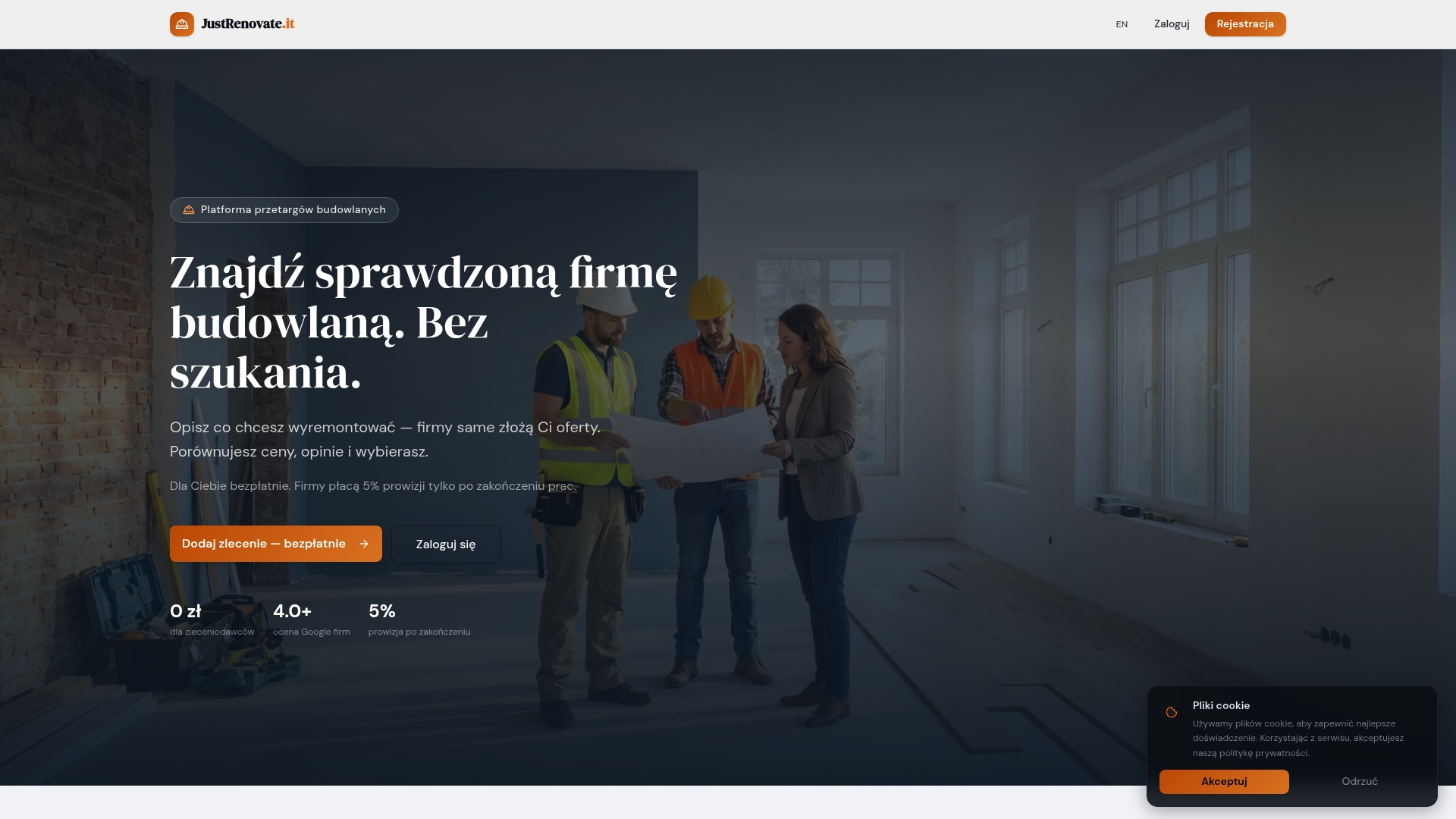
This model removes the most common sources of renovation stress: finding trustworthy contractors, comparing inconsistent quotes, and managing communication across multiple parties. Everything is centralized, documented, and designed to protect your interests. You can see active renovation tenders right now and get a clear sense of how competitive and transparent the process really is. If you are planning a renovation in 2026, starting with a platform that combines AI-powered scoping with verified contractor competition is the most practical first step you can take.
Frequently asked questions
What types of renovation tasks are most commonly automated in Poland?
The most common automated tasks include project management, cost estimation, smart home system integration, and increasingly physical tasks like facade inspection, insulation application, and precise construction marking.
How much can I save by using automation in my renovation?
Intelligent building systems reduce operational costs by 20 to 30% in Polish buildings, with automated lighting delivering up to 80% savings compared to conventional lighting setups.
What are the biggest challenges to adopting automation in renovation?
The main barriers are upfront investment costs, integration difficulties with older building systems, and the ongoing need for human expertise to manage complex decisions that automation cannot handle reliably on its own.
Can automation help me find reliable renovation contractors?
Yes. Platforms like OSS krk HubRenowacji and justRenovate.it use digital coordination to match homeowners with vetted, rated contractors, making the selection process faster, more transparent, and significantly less stressful than traditional methods.
Are robotics available for my home renovation today?
Robotics are currently in active pilot stages for tasks like facade inspection and insulation in Poland and across the EU, with commercial availability expected to grow significantly over the next three to five years.