

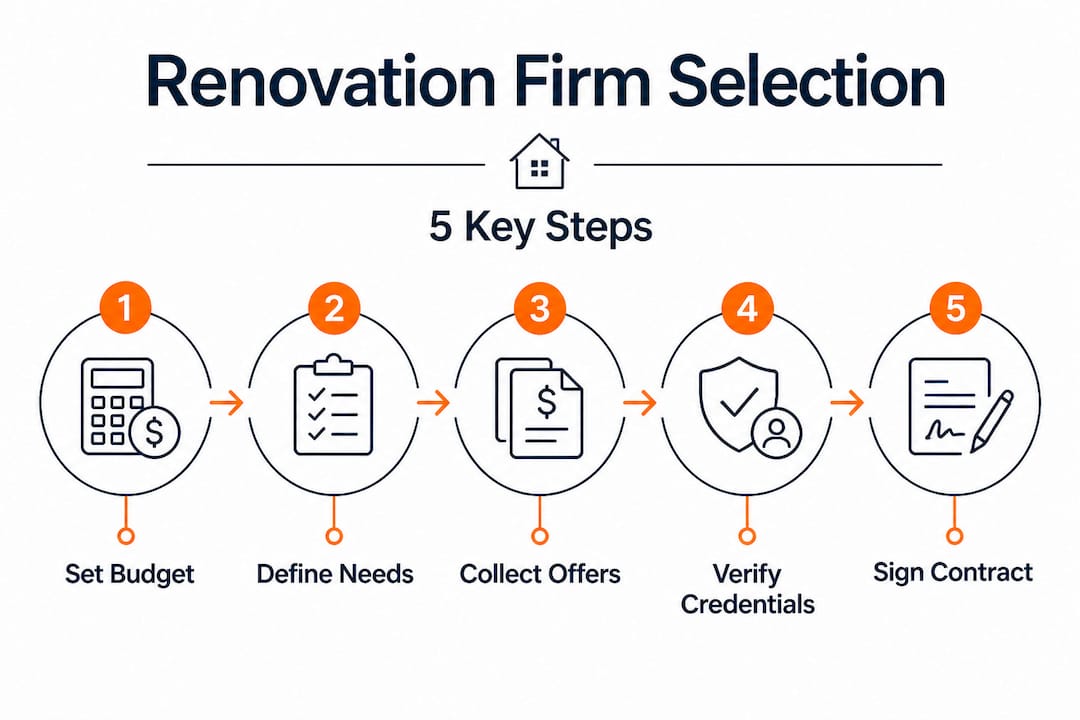
Hiring the wrong building firm is one of the most expensive mistakes a homeowner can make. Projects drag on for months past their deadline, costs spiral well beyond the original estimate, and the finished work looks nothing like what was promised. It does not have to go that way. With the right preparation and a clear, step-by-step selection process, you can find a trustworthy firm that delivers quality work at a fair price, keeps you informed throughout, and leaves you genuinely satisfied when the last tool is packed away.
Table of Contents
- What to check before contacting building firms
- How to shortlist and compare building firms
- Verifying credentials and protecting your interests
- Negotiating smart contracts and payment plans
- Quality control: Should you hire an external inspector?
- What most homeowners overlook when hiring building firms
- Find trusted building firms in Poland with JustRenovate.it
- Frequently asked questions
Key Takeaways
| Point | Details |
|---|---|
| Prepare your project | Define your renovation scope and gather key documents before contacting firms. |
| Compare several offers | Collect and analyze multiple written proposals to avoid costly mistakes. |
| Verify credentials | Always check building firm registrations, insurance, and references. |
| Use clear contracts | Insist on detailed agreements and pay only for completed work stages. |
| Consider expert oversight | Hiring an independent inspector can protect you from errors if you lack renovation experience. |
What to check before contacting building firms
Before you reach out to a single contractor, you need to get your own house in order. Literally. Homeowners who skip this stage often waste time and money because firms cannot quote accurately on a vague brief, and any estimate you receive will be little more than a rough guess.
Start by gathering the essentials:
- Floor plan or measurements of the space being renovated
- Inspiration materials, such as photos from Pinterest, Houzz, or magazines that show your preferred style
- A list of required work, separated into "must-have" and "nice-to-have" categories
- Notes on any special requirements, such as accessibility needs, energy efficiency goals, or restrictions from a housing cooperative (spółdzielnia)
- Copies of building permits if structural or installation work is involved
- Your realistic budget range, including what you can spend if surprises arise
That last point matters more than most homeowners realize. As a renovation checklist for Polish homeowners shows, knowing your limits in advance helps you negotiate scope instead of being forced into decisions under pressure.
On the topic of budgets: renovation costs in Poland vary considerably by location, standard of finish, and what is being done. Here is a general guide to typical 2026 cost ranges per m² to help you orient your planning:
| Renovation type | Budget finish (PLN/m²) | Standard finish (PLN/m²) | Premium finish (PLN/m²) |
|---|---|---|---|
| Full apartment renovation | 800–1,200 | 1,300–2,000 | 2,100–4,000+ |
| Kitchen renovation only | 1,000–1,500 | 1,600–2,500 | 2,600–5,000+ |
| Bathroom renovation only | 1,200–1,800 | 1,900–3,000 | 3,100–6,000+ |
| Painting and surface work | 40–70 | 75–120 | 130–200+ |
| Flooring installation | 60–120 | 130–200 | 210–400+ |
These ranges are useful starting points, but as renovation cost guides for Poland make clear, treat them as a baseline for conversations and negotiations. Your actual costs depend heavily on location, the quality of fittings you choose, and whether existing installations like plumbing or electrical wiring need to be updated.
Pro Tip: Always add a buffer of 10 to 15 percent on top of your planned budget. Unexpected discoveries are common in renovation work, especially in older buildings. A financial cushion means you can handle surprises without stopping work or compromising on quality.
Once you are sure of your renovation's needs and your budget, the next step is to start searching for building firms that can deliver.
How to shortlist and compare building firms
Finding a reliable firm is not about luck. It is about running a structured comparison. Here is how to do it properly:
- Gather at least three detailed offers. Never rely on a single quote. Comparing multiple proposals gives you leverage, reveals market pricing, and exposes which firms actually understand your project.
- Request itemized breakdowns. A quality offer separates labor costs (robocizna) from material costs (materiały). Lump-sum quotes make it impossible to identify where money goes.
- Check their online presence. Look at Google Reviews, Facebook pages, and any portfolio sections on their websites. Patterns in feedback matter more than individual comments.
- Ask for photos or site visits to past projects. Photographs can be misleading. If possible, ask to see a recently completed project in person.
- Confirm availability. A firm that cannot start within a reasonable window may be overstretched or understaffed.
- Compare response speed. How quickly a firm replies to your initial inquiry tells you a great deal about how they will communicate once work starts.
The approach of collecting multiple offers before committing is consistently highlighted by experienced renovators. As building firm selection guides recommend, use a "staged approach": gather several offers, then verify real-world quality through actual completed projects before making any decision.
Here is an example comparison table to use when reviewing competing offers:
| Criteria | Firm A | Firm B | Firm C |
|---|---|---|---|
| Total estimated cost (PLN) | 45,000 | 38,500 | 52,000 |
| Labor cost itemized separately? | Yes | No | Yes |
| Years in operation | 12 | 3 | 8 |
| Google rating | 4.7 | 4.1 | 4.8 |
| Insurance confirmed? | Yes | Unknown | Yes |
| Portfolio shared? | Yes | No | Yes |
| References available? | Yes | No | Yes |
| Proposed timeline | 8 weeks | 6 weeks | 9 weeks |
Notice that Firm B has the lowest price and fastest timeline, but multiple key quality signals are missing. That combination is a significant warning. The cheapest offer often becomes the most expensive project once delays and rework are factored in.

Understanding automation in renovation project management is also becoming more relevant. Firms that use digital tools for scheduling and communication tend to manage timelines more reliably than those relying on phone calls and handwritten notes.
After collecting a shortlist of firms, you will want to dig deeper to verify their credentials and reliability.
Verifying credentials and protecting your interests
This step separates cautious, confident homeowners from those who end up chasing contractors for months. Always verify before you sign anything.
Here are the essential checks to complete:
- Company registration: Check CEIDG (for sole traders) or KRS (for limited companies) to confirm the firm is legally registered and active. Both databases are freely searchable online.
- Tax status: Confirm the firm has a valid NIP number and is a registered VAT payer if relevant to your project.
- OC insurance (civil liability): This is non-negotiable. An uninsured contractor leaves you financially exposed if an accident damages your property or a neighbor's home.
- Specialist certifications: For electrical, gas, and plumbing work, specific qualifications are legally required in Poland. Always ask for documentation.
- Portfolio authenticity: Cross-reference photos with actual clients where possible. Ask specifically about projects similar to yours in size and scope.
- Recent references: Ask to speak directly with past clients from the last 12 months, not older testimonials.
Insurance is not optional. Before signing any contract, confirm your contractor holds valid OC (odpowiedzialność cywilna) insurance. If anything goes wrong on site, you need that protection. A contractor who hesitates to share their policy documentation is a contractor worth avoiding.
Asking for documents can feel awkward, but frame it simply: "Przygotowuję się do podpisania umowy i chciałbym/chciałabym zobaczyć potwierdzenie ubezpieczenia i uprawnień." Most professional firms respond to this without hesitation. As verification guidance for Polish homeowners points out, checking building firm credentials before signing is a standard part of the process, and any reputable contractor will understand that.
With reputable credentials in hand, there is one more line of defense: your contract and the way you agree to pay.
Negotiating smart contracts and payment plans
A contract is not a formality. It is your main protection if things go wrong. Yet many homeowners sign vague, one-page agreements without realizing how exposed they are. Here is what every solid renovation contract should include:
- Clear scope of work. Every task should be listed explicitly. If it is not in the contract, the contractor has no obligation to do it without extra charge.
- Timeline with milestones. Define a start date, an end date, and key checkpoints in between. Include a clause for what happens if deadlines are missed.
- Staged payment schedule. Never pay the full amount upfront. Tie payments to completed and verified stages of work.
- Extra cost policy. Agree in writing on how additional costs are approved and documented. Verbal agreements on extras are a common source of disputes.
- Materials specification. If you are not supplying materials yourself, name the brands, grades, and quantities you expect. This prevents substitution with cheaper alternatives.
- Guarantee terms. Define the warranty period for both labor and materials. In Poland, the standard warranty period for construction work is typically two to five years depending on the type of work.
On payment specifically: as contract and payment guidance for Polish renovations makes clear, your contract should define payment in stages and milestones, never 100% upfront. Pay an initial deposit, typically 10 to 20 percent, to secure the start date. Then release further installments at agreed milestones, such as completion of demolition, completion of installation work, and final finishing.
Pro Tip: Insist on payment stages tied to your inspection and approval, not just the contractor's word that a stage is complete. A short walk-through at each milestone takes 30 minutes and can save you thousands.
Finally, even with all preparations, an external quality inspector or experienced advisor can add confidence and oversight.
Quality control: Should you hire an external inspector?
For larger projects, or if you have limited construction experience, bringing in an independent inspector (nadzór budowlany or inspektor nadzoru inwestorskiego) is worth considering seriously.
When to consider hiring an inspector:
- Your project involves structural changes, new installations, or permits
- You are renovating a large space (over 60 m²) where mistakes are costly to fix
- You will not be present on site regularly during work
- You have had a bad experience with contractors before
- The project timeline exceeds six weeks
What an inspector typically does:
- Reviews plans and specifications before work starts
- Makes regular site visits to check workmanship quality
- Confirms materials match the agreed specification
- Identifies problems before they are covered up by subsequent work
- Provides written reports you can use if disputes arise
Typical inspection costs range from PLN 1,500 to PLN 6,000 for a full project, depending on scope and how many visits are required. For a PLN 50,000 renovation, that represents 3 to 12 percent of the budget, which is a reasonable insurance premium.
As independent oversight studies note, if you do not have technical construction experience, external quality control can meaningfully reduce the risk of costly corrections later. Some contractors treat supervision as an unnecessary expense. But the homeowners who have lived through a poorly executed renovation tend to see it very differently.
With the entire selection process in view, let us step back for a unique perspective on making confident renovation choices.
What most homeowners overlook when hiring building firms
Here is something the standard advice rarely says directly: paperwork and credentials are the floor, not the ceiling. You can have a contractor with perfect documentation, glowing certificates, and years of experience who still delivers a frustrating, stressful project because they simply do not communicate well.
The homeowners who report the most satisfaction from their renovations consistently mention one thing above everything else: they felt kept in the loop. Their contractor called when there was a problem. They answered messages quickly. They flagged an issue on Tuesday rather than hiding it until Friday's payment was due.
Checking recent references is far more valuable than reading reviews from two or three years ago. Firms change. Teams change. A company that was excellent in 2022 may now be understaffed or operating with a different crew. Always ask references specifically about projects completed in the past six to twelve months.
There is also the temptation to trust a polished portfolio over a genuine site visit. Photographs are curated. Real sites are messy, honest, and revealing. If a firm is confident in their work, they will welcome you visiting a current or recently completed project. If they deflect or make excuses, that tells you something important.
Use your renovator's checklist as an objective guide during meetings with firms. It helps you ask consistent questions and compare answers fairly, rather than being swayed by whoever made the best impression in a single conversation.
Pro Tip: Make your final decision based on evidence you gathered yourself, not on promises made during a sales pitch. Trust is built on track record, not confidence.
Find trusted building firms in Poland with JustRenovate.it
You now have a clear process: prepare thoroughly, collect multiple offers, verify credentials, protect yourself with a solid contract, and stay engaged throughout the project.

JustRenovate.it takes this process and makes it significantly easier. The platform connects you with verified building firms that hold a minimum 4.0 Google rating and participate in a competitive auction system, submitting detailed offers that break down labor and material costs separately. You compare firms on price, experience, and reviews, all in one place. You can post your project in minutes using the AI-guided scope builder, or simply add a job directly. The service is completely free for homeowners. Firms only pay a commission after the project is finished and you confirm you are satisfied. That means every firm on the platform is motivated to deliver quality results.
Frequently asked questions
What documents should I request from building firms before hiring?
Request proof of company registration (CEIDG or KRS), a valid OC insurance policy, certifications for any specialist trades, and references from recent completed projects. These cover your legal and quality risk bases before any work begins.
How many offers should I collect before choosing a building firm?
Collect at least three offers with itemized cost breakdowns. Three offers give you a meaningful price range and reveal how clearly each firm understands your project scope.
Why is staged payment better than paying everything upfront?
Staged payments tie your money to actual completed milestones, which protects you if the contractor slows down, changes crew, or disappears mid-project. Paying everything upfront removes your primary lever of accountability.
Is it worth hiring an external inspector for my renovation project?
If you lack construction experience or your project is large and complex, independent quality inspection is a practical safeguard. Catching a mistake before it is plastered over is always cheaper than fixing it afterward.