

Finding a reliable contractor for your renovation project in Poland can feel overwhelming. The tender process comes with unfamiliar rules, mandatory deposits, and multiple platforms that each operate differently. Whether you own a flat in a housing co-op or manage a commercial property, understanding how tenders work, what fees to expect, and which platforms offer genuine transparency will save you time, money, and serious frustration. This guide walks you through real tender examples, breaks down the rules in plain terms, and helps you compare your options with confidence.
Table of Contents
- Understanding building tenders: types and criteria
- Sample tender: housing co-op renovation with balcony repair
- Comparing tender platforms for Polish property owners
- Choosing the best tender for your renovation project
- Why tender transparency matters more than price
- Connect with reliable contractors on justRenovate.it
- Frequently asked questions
Key Takeaways
| Point | Details |
|---|---|
| Tender types explained | Renovation tenders in Poland include co-op posts, public procurement, and platform-driven listings. |
| Compare offers transparently | Using platforms like EZamówienia and UDT lets you review and select bids safely. |
| Check requirements carefully | Every tender may have unique rules for fees, wadium deposit, and organizer discretion. |
| Prioritize transparency | Choosing platforms with audit features protects you and encourages honest competition. |
Understanding building tenders: types and criteria
From the overview, let's dig into the actual types and rules that shape the tender process in Poland.
Building tenders in Poland are not one-size-fits-all. There are several distinct formats, and each one comes with its own set of participation rules, documentation requirements, and fee structures. Knowing the difference before you engage with any tender notice will help you prepare the right materials and avoid disqualification on a technicality.
The three most common tender types you will encounter include:
- Open tender (przetarg nieograniczony): Any qualified contractor can submit a bid without prior pre-qualification. These are the most transparent and widely used for public-sector projects.
- Restricted tender (przetarg ograniczony): Only pre-selected contractors receive an invitation to bid. The organizer filters candidates first, reducing the pool intentionally.
- Written non-restricted tender (przetarg pisemny nieograniczony): Common in housing co-ops and private organizations, this format allows any party to participate in writing, often with a fee for accessing tender documents.
For private property owners and housing communities in Poland, renovation procurement examples appear regularly as tenders posted by housing co-ops (spółdzielnie mieszkaniowe) with clearly stated participation rules, fee structures, and wadium deposit requirements. Understanding what each tender type demands from participants is the first step to submitting a competitive, compliant bid.
Beyond the tender type, you need to understand common participation criteria. Most tenders require:
- Proof of business registration or legal capacity to contract
- Payment of a document access fee (typically a few hundred złotych)
- A wadium deposit, which is a refundable security amount that proves you are a serious bidder
- Specific technical certifications or prior project experience relevant to the scope of work
It is also worth reviewing renovation contract templates before you engage with any tender, because the contract terms embedded in tender documents often determine your obligations before any negotiation begins.
Important: Polish tender organizers, including private housing co-ops, typically reserve the right to cancel a tender or select no bid at all without explaining their reasoning. Always read the discretion clause before investing time in your submission.
Pro Tip: Never assume that the lowest price wins automatically. In many written non-restricted tenders, the organizer weighs multiple criteria including experience, references, proposed timeline, and technical approach. Price is just one factor.
Sample tender: housing co-op renovation with balcony repair
Now, let's see how these rules play out in a real-life tender for balcony repair.
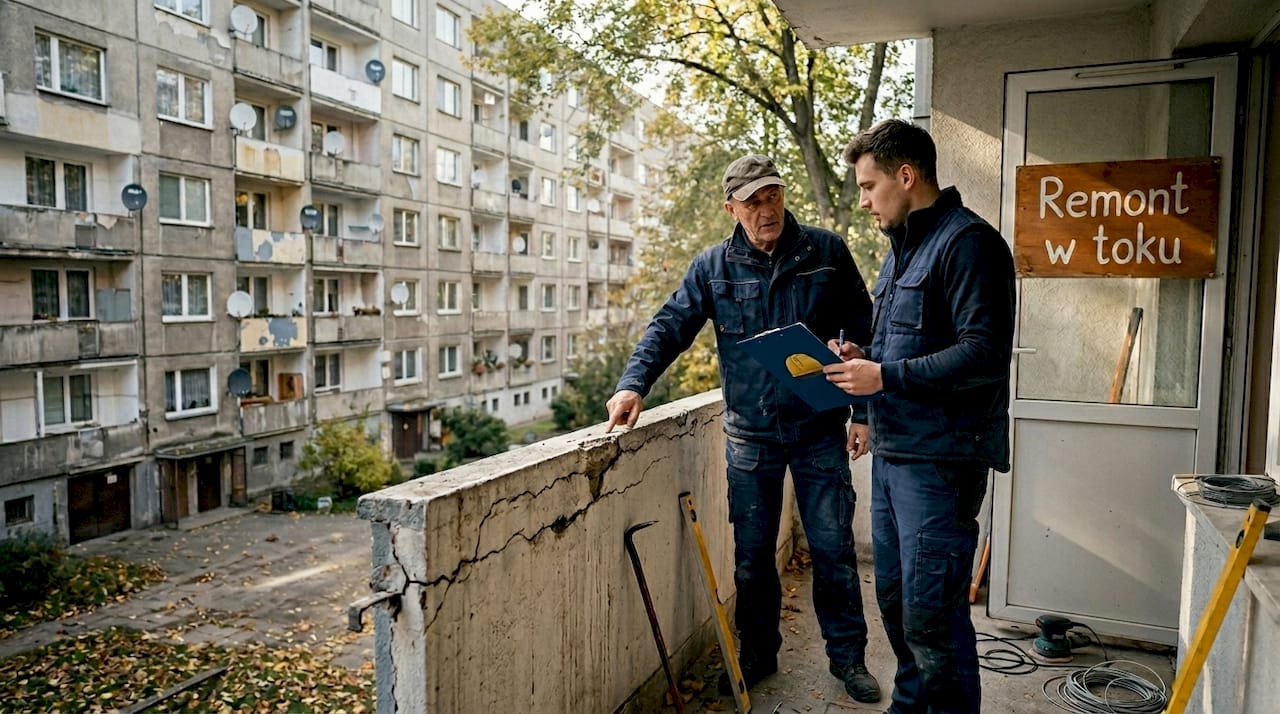
Real tenders provide the clearest picture of what property owners and contractors actually encounter. Czeladzka Spółdzielnia Mieszkaniowa advertised a written non-restricted tender for balcony repair works, with materials sent by email after paying a fee and a required wadium deposit for participation. This type of tender is representative of what thousands of Polish housing communities post every year, and it illustrates how the process works in practice.
Here is a step-by-step breakdown of how that process typically unfolds for a tender like this:
- Notice publication: The co-op posts the tender announcement on its official website or bulletin board, specifying the scope of work (in this case, balcony repair across multiple residential buildings), the deadline, and contact details.
- Fee payment for documents: Interested contractors pay a small administrative fee, usually by bank transfer, to receive the full tender documentation package via email.
- Wadium deposit submission: Before the bid deadline, contractors transfer the required wadium amount into the co-op's bank account. This deposit is held as a security guarantee.
- Bid preparation and submission: Contractors prepare a written offer including cost breakdown for robocizna (labor), materiałów (materials), proposed timeline, and any technical documentation.
- Bid evaluation: The organizer reviews all submitted bids against the stated criteria and may interview shortlisted contractors.
- Wadium refund or retention: Winning and losing contractors typically receive their wadium refunded, unless the winner withdraws or fails to sign the contract within the stated period.
Here is a quick data comparison of what a typical housing co-op balcony repair tender looks like versus a public procurement tender:
| Feature | Co-op written tender | Public open tender (EZamówienia) |
|---|---|---|
| Who can participate | Any registered contractor | Any qualified business |
| Document access | Fee-based, sent by email | Free download via platform |
| Wadium required | Yes, amount specified | Depends on contract value |
| Submission method | Written, via email or post | Digital, via encrypted platform |
| Organizer discretion | High, cancellation possible | Moderate, regulated by PZP |
| Transparency level | Medium | High |
A few details deserve special attention when you review building tender deposit rules. The wadium refund timeline is often unclear in private co-op tenders. Some co-ops return deposits within 7 days of the decision; others take 30 days or longer. If this is not stated explicitly, ask before you pay.
Pro Tip: Always confirm the exact conditions under which wadium can be forfeited. Most tenders retain the deposit if you win the bid but fail to sign the contract within the stated period. Check the home renovation checklist to make sure your documents and financials are ready before you submit.
Comparing tender platforms for Polish property owners
With a concrete tender example covered, let's now evaluate which platforms help you compare offers transparently.
Not all tender platforms are created equal. Some exist purely to list notices while others provide full bid management, document handling, and encrypted submission features. For property owners and contractors in Poland, choosing the right platform affects how easily you can access, compare, and submit competitive offers.
Here are the key platforms worth knowing:
- EZamówienia (ezamowienia.gov.pl): Poland's central public procurement platform, linked to the official Biuletyn Zamówień Publicznych (BZP). You can browse BZP procurement listings to find renovation-related tenders across municipalities, public institutions, and housing authorities. It is free to access and provides a high-level overview of active procedures.
- UDT procurement platform: The Urząd Dozoru Technicznego (Technical Inspection Authority) uses a dedicated procurement platform for subthreshold orders below 170,000 PLN as well as PZP-regulated procedures. The platform supports downloading documents, submitting bids and questions through the system, and uses encryption for submitted documents, which is directly relevant to transparency and auditability for contractors and property owners.
- Private co-op websites: Many housing co-ops publish tenders directly on their own websites or bulletin boards, without using any centralized platform. Access to documents typically requires contacting the co-op directly or paying a fee.
- Commercial tender aggregators: Third-party websites aggregate tender notices from multiple sources, useful for contractors who want to monitor opportunities across Poland without visiting individual organization websites.
Here is a side-by-side comparison to help you evaluate which platform fits your situation best:
| Platform | Cost to access | Encrypted submissions | Bid comparison tools | Best for |
|---|---|---|---|---|
| EZamówienia | Free | Yes | Limited | Public tenders, broad search |
| UDT platform | Free | Yes | Moderate | Subthreshold and PZP tenders |
| Co-op website | Fee for docs | No | None | Local housing projects |
| justRenovate.it | Free for owners | N/A | Full comparison tools | Private renovation projects |
Automation in the tender process is increasingly important. Platforms that automate document delivery, bid tracking, and evaluation scoring save significant time compared to manually managing email-based submissions. This is especially valuable when you are comparing five or more contractors simultaneously.
Expert perspective: Document access and encrypted bid submission are not just technical features. They are trust signals. When contractors know their pricing cannot be seen before the deadline, they bid honestly. That is how you get genuinely competitive offers.
If you want a structured approach to selecting reliable contractors, using a platform with verifiable contractor ratings and structured offer comparison removes much of the guesswork from the evaluation process.
Choosing the best tender for your renovation project
Finally, let's bring everything together to help you choose wisely based on your renovation needs.
Selecting the right tender format and platform comes down to three core factors: the size and complexity of your project, the level of transparency you need, and how much administrative work you are willing to manage yourself.
Here is a practical framework for matching your situation to the right approach:
- Small projects under 50,000 PLN: A direct invitation to two or three contractors with written quotes is often more efficient than a formal tender. However, if you want competitive pricing, posting on a platform that structures the comparison for you gives better results.
- Mid-size projects (50,000 to 170,000 PLN): This is the subthreshold range where platforms like UDT's procurement system are designed to help. You can publish your requirements, use encrypted submissions to protect bid confidentiality, and maintain an audit trail for every step.
- Large or complex renovation projects: A formal PZP-compliant procedure via EZamówienia may be required if public funds are involved. For private owners, structured platforms with verified contractors are still the better choice.
Budget considerations matter beyond just the contract value. Remember to account for:
- Wadium deposit amounts, which can tie up several thousand złotych for weeks
- Document access fees, which vary by organizer and are rarely refundable
- The cost of preparing a professional tender response, which may require an estimator or legal review
The refundability of the wadium depends heavily on which tender you enter and the specific terms. Always read the refund clause carefully. Some co-ops do not refund the deposit to non-winning bidders within a reasonable timeline, which creates cash flow problems for smaller contractors.
Pro Tip: Prioritize tender platform alternatives that use encrypted submissions if your renovation project is significant in value. An encrypted audit trail protects both you and the contractors you invite, and it creates a verifiable record if any dispute arises later. Transparency at the submission stage prevents many costly disagreements down the line.
Why tender transparency matters more than price
With practical selection advice in hand, here is what experience with Polish renovation tenders reveals about what really counts.
Everyone says they want the best price. That is understandable. Renovation projects are expensive and budgets are tight. But focusing only on the lowest number in the bid column is one of the most common and costly mistakes property owners make.
Here is the uncomfortable truth: a contractor who submits the cheapest bid often does so because they have excluded something from their scope, underestimated material costs, or plan to recover their margin through extras and change orders later. When you choose based on price alone, you are essentially choosing the contractor who is least transparent about the real cost of your project.
Transparency in the tender process prevents disputes before they start. When every bid is submitted through an encrypted, auditable system, and when the evaluation criteria are clearly stated upfront, contractors have no incentive to game the numbers. They know the organizer can see exactly what is included and what is not. That discipline produces honest, comparable offers.
Platforms that provide contract best practices alongside their tender tools help property owners understand what a complete bid looks like. When you know what should be included, you can spot the contractor who left out scaffolding costs or disposal fees. That knowledge is worth more than any savings from accepting the lowest number.
Audit trails also matter after the project is finished. If a dispute arises over scope, timeline, or payment, having a documented record of what each contractor bid and what the winning contractor promised gives you a clear basis for resolution. Without that paper trail, disputes become your word against theirs. That is an expensive place to be.
Choose transparency over price. The projects that go smoothly are almost always the ones where expectations were set clearly from the first document to the final invoice.
Connect with reliable contractors on justRenovate.it
Now that you understand the tender process, here is how justRenovate.it can help streamline your search and ensure transparency.
justRenovate.it is a renovation tender platform built specifically for Polish property owners who want competitive, verified bids without the administrative headache of traditional procurement. You describe your project using our AI-assisted intake process, and verified building firms with Google ratings of at least 4.0 compete for your work.

You can browse current open tenders to see how other property owners are posting their renovation requirements and what kinds of offers they receive. Every offer includes a detailed breakdown of robocizny and materiałów so you can compare apples to apples. The platform is completely free for property owners. Building firms pay a commission only after your project is completed and you confirm satisfaction. Ready to get started? Submit your project and let verified contractors compete for your renovation work today.
Frequently asked questions
What is wadium and why is it required for building tenders in Poland?
Wadium is a refundable deposit required to participate in building tenders, used to ensure serious bidding and prevent last-minute withdrawal. For example, Czeladzka Spółdzielnia Mieszkaniowa includes a required wadium amount in its balcony repair tender alongside a document access fee.
Can I compare multiple renovation offers on Polish procurement platforms?
Yes, platforms like EZamówienia and UDT let you access and compare bids from various contractors in a transparent interface, with each platform offering different levels of bid management and document handling.
How do I get tender documents for a renovation project?
Documents are usually sent after paying a fee or via download from the platform; check the tender notice for exact collection rules. In the Czeladzka Spółdzielnia Mieszkaniowa tender, materials were sent by email after fee payment was confirmed.
Do tender platforms provide secure and transparent offer submission?
Yes, platforms like UDT feature encrypted document handling, secure bid submissions, and audit trails to ensure that all submitted offers remain confidential until the evaluation stage and verifiable afterward.